Metabolic Memory: Developing a Visceral Homeland

Project 001

Project 002

Project 003
Project 003

Project 003

Project 003

Project 003
Project 001
Project 002
Project 003
Project 003
Project 003
Project 003
Project 003
Project 001
Project 002
Project 003
Project 003
Project 003
Project 003
Project 003
Project 001
Project 002
Project 003
Project 003
Project 003
Project 003
Project 003
In a contemporary world where intensified mobility continues to accelerate—at times even spinning out of control—“home” is gradually losing its established coordinates. When those coordinates can no longer migrate with us, the individual body becomes the final site of dwelling. Yet across geographical and cultural boundaries, indigenous microbial communities are increasingly eroded by the homogenizing conditions of relocated environments, undergoing a silent form of biological erasure.
Beginning from this condition, the work seeks to reconceive home as a mobile practice woven through multispecies symbiosis. The microbiome within the body is understood as the subject’s deeply embedded internal homeland. Sustained by fermented substances from one’s place of origin, this portable terroir resists assimilation and establishes a system of documentation that accommodates transformation, decay, and decomposition. It preserves the body’s transient material testimony, allowing belonging to be sensed anew through states of instability, leakage, and continuous coexistence with others.
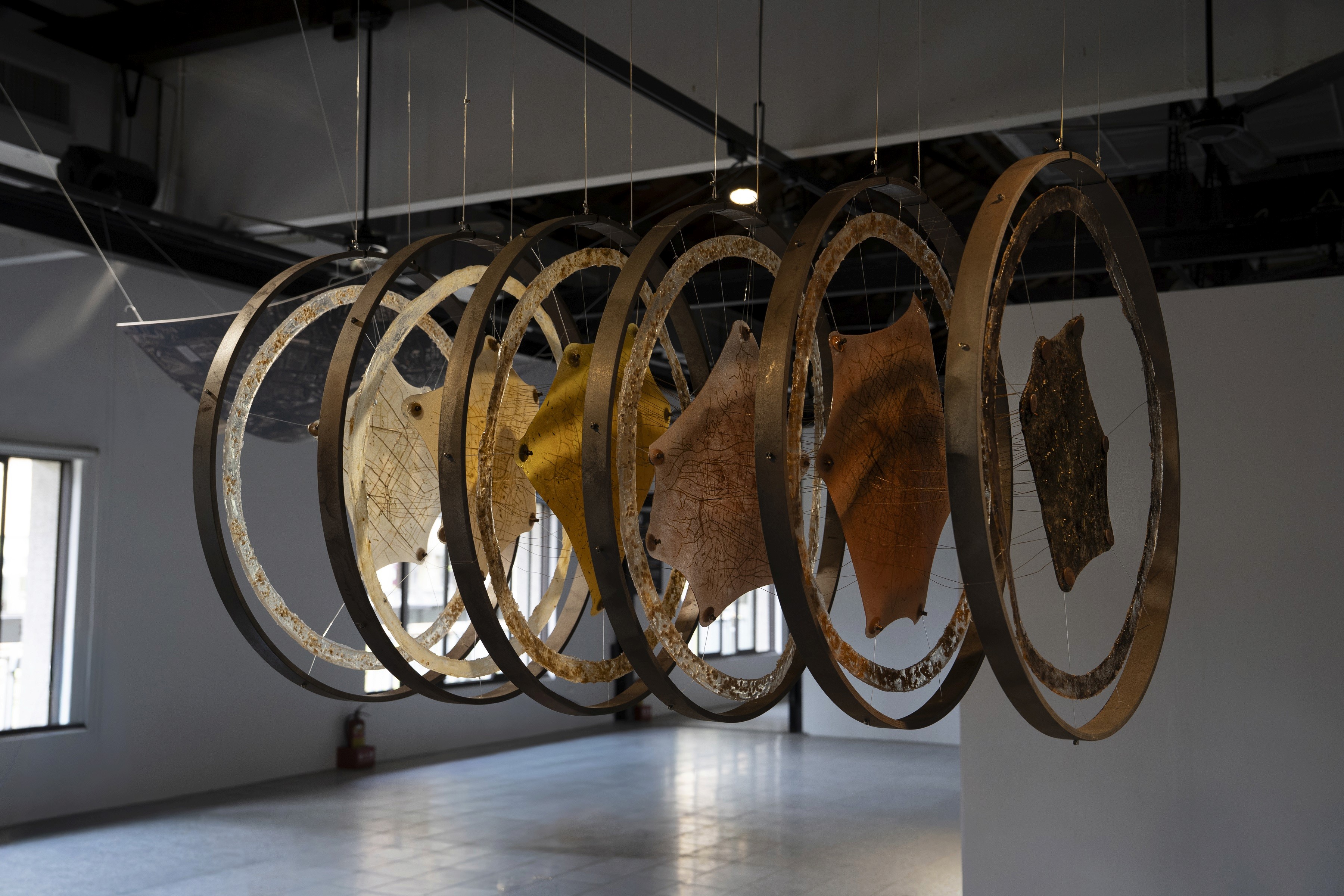
Within the installation, rigid structural tensions constrain a medium composed of bioplastic membranes and fermented remnants. Through physical stretching and pulling, the work materializes the microscopic struggle between external norms and indigenous memory. The surfaces of the membranes retain colors, sediments, stains, and irregular textures produced during fermentation, occupying an ambiguous state between skin, culture medium, bodily tissue sections, and microbial landscapes.
Dense threads traverse the membranes like fungal hyphae, neural networks, or migratory routes drawn across a map. Memory continues to emerge through processes of interweaving, tension, connection, and extension. Viewed through overlapping layers resembling culture media, the work reveals an internal landscape composed of microorganisms, embodied experience, and memories of migration.
In a contemporary world where intensified mobility continues to accelerate—at times even spinning out of control—“home” is gradually losing its established coordinates. When those coordinates can no longer migrate with us, the individual body becomes the final site of dwelling. Yet across geographical and cultural boundaries, indigenous microbial communities are increasingly eroded by the homogenizing conditions of relocated environments, undergoing a silent form of biological erasure.
Beginning from this condition, the work seeks to reconceive home as a mobile practice woven through multispecies symbiosis. The microbiome within the body is understood as the subject’s deeply embedded internal homeland. Sustained by fermented substances from one’s place of origin, this portable terroir resists assimilation and establishes a system of documentation that accommodates transformation, decay, and decomposition. It preserves the body’s transient material testimony, allowing belonging to be sensed anew through states of instability, leakage, and continuous coexistence with others.
Within the installation, rigid structural tensions constrain a medium composed of bioplastic membranes and fermented remnants. Through physical stretching and pulling, the work materializes the microscopic struggle between external norms and indigenous memory. The surfaces of the membranes retain colors, sediments, stains, and irregular textures produced during fermentation, occupying an ambiguous state between skin, culture medium, bodily tissue sections, and microbial landscapes.
Dense threads traverse the membranes like fungal hyphae, neural networks, or migratory routes drawn across a map. Memory continues to emerge through processes of interweaving, tension, connection, and extension. Viewed through overlapping layers resembling culture media, the work reveals an internal landscape composed of microorganisms, embodied experience, and memories of migration.
In a contemporary world where intensified mobility continues to accelerate—at times even spinning out of control—“home” is gradually losing its established coordinates. When those coordinates can no longer migrate with us, the individual body becomes the final site of dwelling. Yet across geographical and cultural boundaries, indigenous microbial communities are increasingly eroded by the homogenizing conditions of relocated environments, undergoing a silent form of biological erasure.
Beginning from this condition, the work seeks to reconceive home as a mobile practice woven through multispecies symbiosis. The microbiome within the body is understood as the subject’s deeply embedded internal homeland. Sustained by fermented substances from one’s place of origin, this portable terroir resists assimilation and establishes a system of documentation that accommodates transformation, decay, and decomposition. It preserves the body’s transient material testimony, allowing belonging to be sensed anew through states of instability, leakage, and continuous coexistence with others.
Within the installation, rigid structural tensions constrain a medium composed of bioplastic membranes and fermented remnants. Through physical stretching and pulling, the work materializes the microscopic struggle between external norms and indigenous memory. The surfaces of the membranes retain colors, sediments, stains, and irregular textures produced during fermentation, occupying an ambiguous state between skin, culture medium, bodily tissue sections, and microbial landscapes.
Dense threads traverse the membranes like fungal hyphae, neural networks, or migratory routes drawn across a map. Memory continues to emerge through processes of interweaving, tension, connection, and extension. Viewed through overlapping layers resembling culture media, the work reveals an internal landscape composed of microorganisms, embodied experience, and memories of migration.