After Remediation (2043-2046)
Project 001
Project 002

Project 003

Project 003

Project 003

Project 003

Project 003

Project 003
Project 001
Project 002
Project 003
Project 003
Project 003
Project 003
Project 003
Project 003
Project 001
Project 002
Project 003
Project 003
Project 003
Project 003
Project 003
Project 003
Project 001
Project 002
Project 003
Project 003
Project 003
Project 003
Project 003
Project 003
Under contemporary regimes of technological governance, the body is no longer understood as an organic whole, but as a set of output interfaces awaiting calibration. Expressive responses and emotional sensations are no longer regarded as experiences in themselves; instead, they are reduced to modular units that can be measured, predetermined, and standardized. Once these modules are incorporated into educational, medical, and technological institutions, individuals are inescapably absorbed into systems of synchronization.
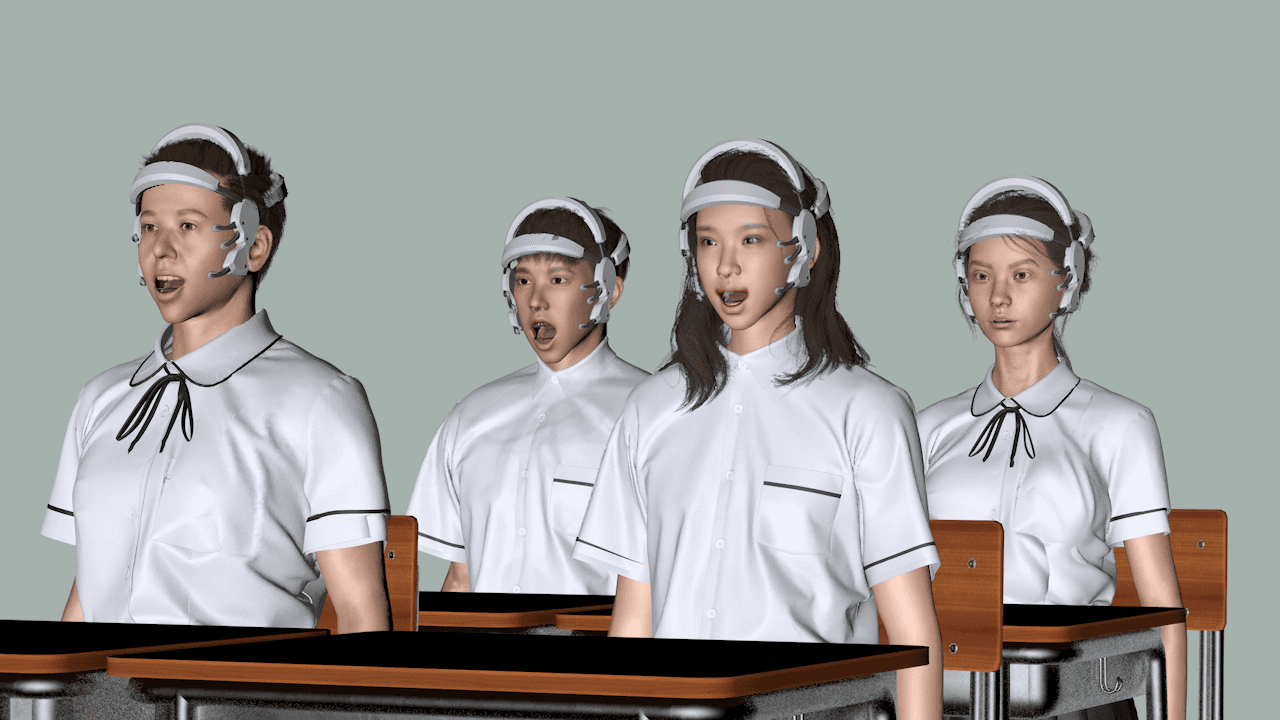
This work begins with a fictional near-future policy in Taiwan, the Pilot Program for the Integrated Development of Adolescent Perception, and reconstructs a world in which educational governance and perceptual design have become deeply intertwined. Developed in response to issues such as delayed language development and difficulties in social adaptation, the program introduces a wearable perceptual synchronization device known as CE-Sync—the Cranio-Emotive Synchronizer—for trial use in selected public junior and senior high schools.
Drawing on orthognathic technologies, electromyography, and neurofeedback systems, the device regulates temporomandibular tension, occlusal pressure, and vocal output. It is deployed as an instructional aid for speech training and emotional synchronization. Entire classes are required to wear the device and undergo standardized training programs, making its use part of both technological literacy and adaptation to social contexts.
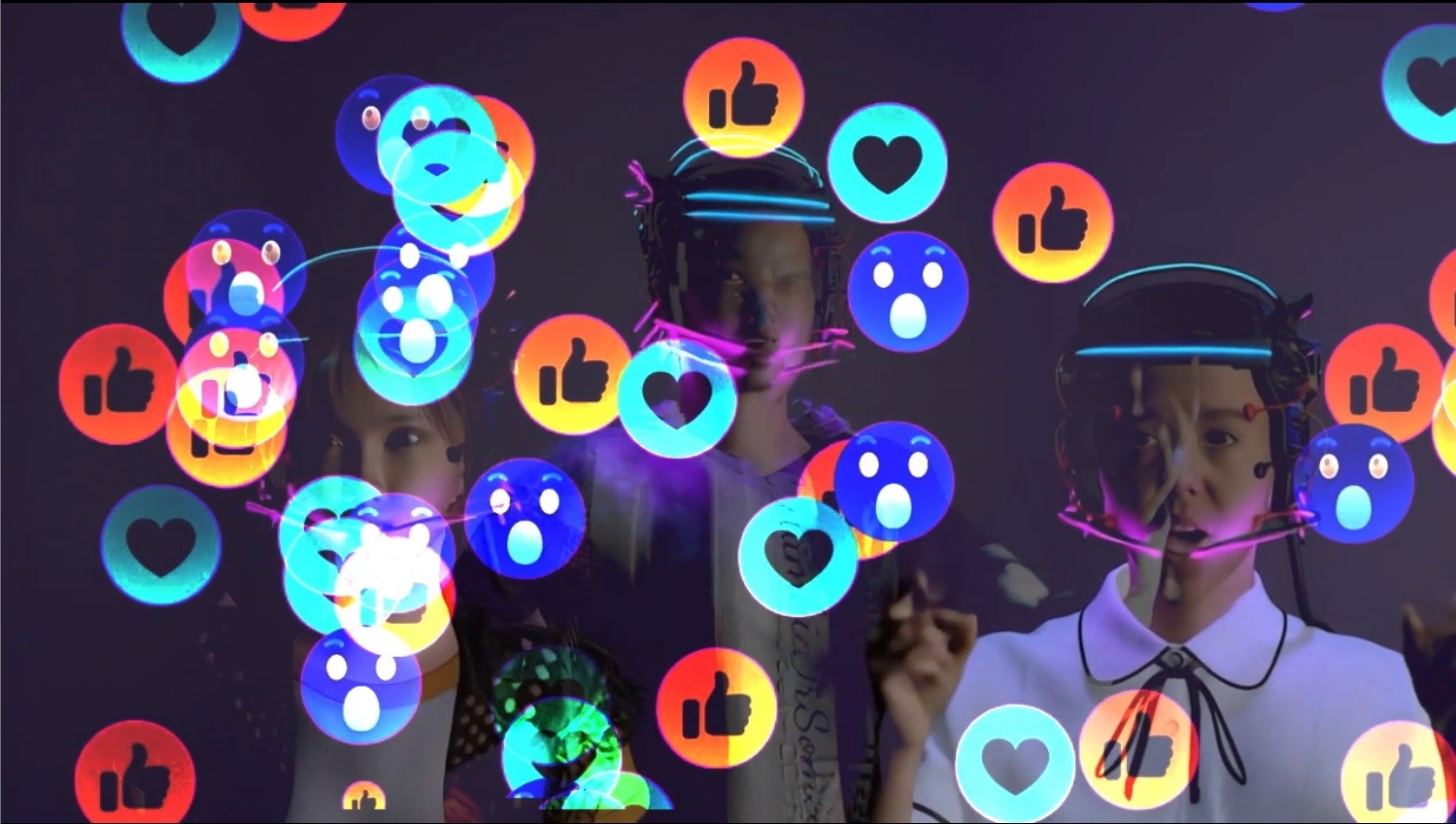
Following the introduction of a “mode-switching function” by an outsourced contractor, however, the device—originally designed as an assistive educational tool—is rapidly hacked and rewritten by student maker communities. Unofficial modules, including Insult Mode, Romance Mode, and Rap Mode, quickly circulate. The rhythms of speech cease to function merely as targets of control and instead become performative styles, turning the device into an interface for self-expression and a weapon of social interaction.
As the phenomenon spreads beyond the school environment and goes viral on social media, the appearance of the device is increasingly appropriated and stylized. Large quantities of nonfunctional facial accessories resembling the synchronizer begin circulating through night markets and online retailers. Mainstream media labels the trend a “street perception revolution,” while designers and fashion brands quickly intervene, stripping the device of its function while retaining its visual symbolism. The synchronizer is thus transformed into a marker of identity and a new vocabulary of the market.
Within the future imagined by this work, perception and expression have become points of intersection between institutional governance and social expectation. Through the device’s correction of the musculature of the head, neck, and oral cavity, individuals no longer act according to their own experiences. Instead, they perform perception according to prescribed “norms of appropriate expression.” The synchronizer is therefore more than a device: it constitutes a new behavioral standard produced through technology.
As these systematic forms of discipline permeate style, commodities, and fashion, governance no longer appears solely as an external force. It is internalized as an impetus for self-monitoring and self-correction. Through the selection of modules, the adjustment of emotional states, and the ornamentation of the face, individual style is performed in tacit coordination with the conventions of specific social contexts. Mechanisms of control thus become inseparable from the desire to construct and display identity.
Under contemporary regimes of technological governance, the body is no longer understood as an organic whole, but as a set of output interfaces awaiting calibration. Expressive responses and emotional sensations are no longer regarded as experiences in themselves; instead, they are reduced to modular units that can be measured, predetermined, and standardized. Once these modules are incorporated into educational, medical, and technological institutions, individuals are inescapably absorbed into systems of synchronization.
This work begins with a fictional near-future policy in Taiwan, the Pilot Program for the Integrated Development of Adolescent Perception, and reconstructs a world in which educational governance and perceptual design have become deeply intertwined. Developed in response to issues such as delayed language development and difficulties in social adaptation, the program introduces a wearable perceptual synchronization device known as CE-Sync—the Cranio-Emotive Synchronizer—for trial use in selected public junior and senior high schools.
Drawing on orthognathic technologies, electromyography, and neurofeedback systems, the device regulates temporomandibular tension, occlusal pressure, and vocal output. It is deployed as an instructional aid for speech training and emotional synchronization. Entire classes are required to wear the device and undergo standardized training programs, making its use part of both technological literacy and adaptation to social contexts.
Following the introduction of a “mode-switching function” by an outsourced contractor, however, the device—originally designed as an assistive educational tool—is rapidly hacked and rewritten by student maker communities. Unofficial modules, including Insult Mode, Romance Mode, and Rap Mode, quickly circulate. The rhythms of speech cease to function merely as targets of control and instead become performative styles, turning the device into an interface for self-expression and a weapon of social interaction.
As the phenomenon spreads beyond the school environment and goes viral on social media, the appearance of the device is increasingly appropriated and stylized. Large quantities of nonfunctional facial accessories resembling the synchronizer begin circulating through night markets and online retailers. Mainstream media labels the trend a “street perception revolution,” while designers and fashion brands quickly intervene, stripping the device of its function while retaining its visual symbolism. The synchronizer is thus transformed into a marker of identity and a new vocabulary of the market.
Within the future imagined by this work, perception and expression have become points of intersection between institutional governance and social expectation. Through the device’s correction of the musculature of the head, neck, and oral cavity, individuals no longer act according to their own experiences. Instead, they perform perception according to prescribed “norms of appropriate expression.” The synchronizer is therefore more than a device: it constitutes a new behavioral standard produced through technology.
As these systematic forms of discipline permeate style, commodities, and fashion, governance no longer appears solely as an external force. It is internalized as an impetus for self-monitoring and self-correction. Through the selection of modules, the adjustment of emotional states, and the ornamentation of the face, individual style is performed in tacit coordination with the conventions of specific social contexts. Mechanisms of control thus become inseparable from the desire to construct and display identity.
Under contemporary regimes of technological governance, the body is no longer understood as an organic whole, but as a set of output interfaces awaiting calibration. Expressive responses and emotional sensations are no longer regarded as experiences in themselves; instead, they are reduced to modular units that can be measured, predetermined, and standardized. Once these modules are incorporated into educational, medical, and technological institutions, individuals are inescapably absorbed into systems of synchronization.
This work begins with a fictional near-future policy in Taiwan, the Pilot Program for the Integrated Development of Adolescent Perception, and reconstructs a world in which educational governance and perceptual design have become deeply intertwined. Developed in response to issues such as delayed language development and difficulties in social adaptation, the program introduces a wearable perceptual synchronization device known as CE-Sync—the Cranio-Emotive Synchronizer—for trial use in selected public junior and senior high schools.
Drawing on orthognathic technologies, electromyography, and neurofeedback systems, the device regulates temporomandibular tension, occlusal pressure, and vocal output. It is deployed as an instructional aid for speech training and emotional synchronization. Entire classes are required to wear the device and undergo standardized training programs, making its use part of both technological literacy and adaptation to social contexts.
Following the introduction of a “mode-switching function” by an outsourced contractor, however, the device—originally designed as an assistive educational tool—is rapidly hacked and rewritten by student maker communities. Unofficial modules, including Insult Mode, Romance Mode, and Rap Mode, quickly circulate. The rhythms of speech cease to function merely as targets of control and instead become performative styles, turning the device into an interface for self-expression and a weapon of social interaction.
As the phenomenon spreads beyond the school environment and goes viral on social media, the appearance of the device is increasingly appropriated and stylized. Large quantities of nonfunctional facial accessories resembling the synchronizer begin circulating through night markets and online retailers. Mainstream media labels the trend a “street perception revolution,” while designers and fashion brands quickly intervene, stripping the device of its function while retaining its visual symbolism. The synchronizer is thus transformed into a marker of identity and a new vocabulary of the market.
Within the future imagined by this work, perception and expression have become points of intersection between institutional governance and social expectation. Through the device’s correction of the musculature of the head, neck, and oral cavity, individuals no longer act according to their own experiences. Instead, they perform perception according to prescribed “norms of appropriate expression.” The synchronizer is therefore more than a device: it constitutes a new behavioral standard produced through technology.
As these systematic forms of discipline permeate style, commodities, and fashion, governance no longer appears solely as an external force. It is internalized as an impetus for self-monitoring and self-correction. Through the selection of modules, the adjustment of emotional states, and the ornamentation of the face, individual style is performed in tacit coordination with the conventions of specific social contexts. Mechanisms of control thus become inseparable from the desire to construct and display identity.
〈After Remediation (2043–2046)〉• Mixed Media (multi-channel CGI video, 3D-printed objects, and found objects) • Dimensions Variable • 2025
〈After Remediation (2043–2046)〉• Mixed Media (multi-channel CGI video, 3D-printed objects, and found objects) • Dimensions Variable • 2025
〈After Remediation (2043–2046)〉• Mixed Media (multi-channel CGI video, 3D-printed objects, and found objects) • Dimensions Variable • 2025